The mother of Alexander the Great
Back to all places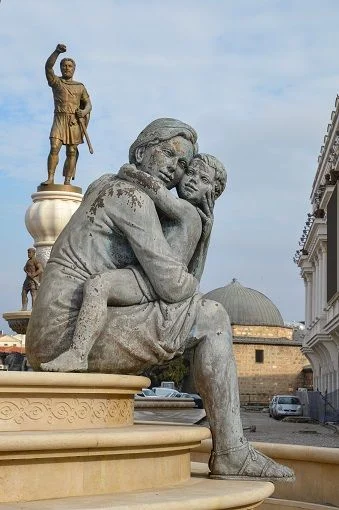
As you are in the country of North Macedonia, it is inevitable to talk about ancient Macedonia. Despite the fact that the political center of the ancient kingdom of Macedonia is situated in modern-day Northern Greece, the heritage of these incredible people has played a crucial role in forming the national identity of the people of modern North Macedonia. Of course, the most famous figure of the Macedonian kingdom is Alexander the Great. But you should remember that he is a product of two remarkable human beings- his father Philip the Second, for whom we will talk a bit later, and one of the most amazing women in the Ancient world- Olympias. Olympias, born around 375 BCE, was the daughter of Neoptolemus I, king of Epirus, and part of a lineage believed to trace back to the hero Achilles. This ancestry became a significant influence on her son, Alexander the Great, who saw himself as part of a heroic tradition. Her early life and marriage to Philip II of Macedon would shape the political dynamics of Macedonia and influence her son’s destiny. Olympias met Philip II at a young age, reportedly falling in love during a religious ceremony on the island of Samothrace. Philip, taken with her beauty and lineage, married her with the approval of her family. However, their relationship quickly became tumultuous, marked by both passion and power struggles. Plutarch tells us that Olympias had a powerful and at times unsettling personality, immersing herself in the mystical Orphic and Dionysian cults. She was known to keep snakes as part of these religious rituals, which disturbed many, including Philip, who reportedly grew wary of her, suspecting her of using supernatural influence. Olympias gave birth to Alexander in 356 BCE, an event wrapped in mythology. According to Plutarch, a thunderbolt appeared in her dreams before his birth, symbolizing divine favor. Legends even suggested that Zeus himself, in the form of a snake, was Alexander’s true father. This myth would contribute to Alexander’s self-image as divinely ordained to rule, a belief encouraged by Olympias, who often reminded him of his supposedly divine origins. Philip and Olympias’s marriage deteriorated as Philip took multiple wives, common for Macedonian kings. The final blow to their relationship came when Philip married Cleopatra Eurydice, a Macedonian noblewoman. This union threatened Olympias and Alexander’s positions because, unlike Olympias, Cleopatra was Macedonian, and her children would have a stronger claim to the throne. At Cleopatra’s wedding, her uncle Attalus publicly wished for a “legitimate heir,” implicitly questioning Alexander’s legitimacy. Outraged, Alexander confronted Attalus, and Philip, siding with his new in-laws, nearly drew his sword against his own son in a drunken rage. Following this incident, Olympias and Alexander fled to her native Epirus. She stayed there until the wedding of her daughter, also called Cleopatra. This wedding was the motive for reconciliation between Alexander and his father. Phillip decided that this event would be the triumph of his achievements but it became famous for Philip’s assassination in 336 BCE. After Philip’s death, Olympias eliminated her rivals decisively. According to Plutarch, she had Cleopatra Eurydice and her infant son murdered, solidifying Alexander’s claim to the throne. Once Alexander ascended to the throne, Olympias remained a powerful force in Macedonian politics. While he campaigned across Asia, she wielded influence at home, often clashing with Antipater, whom Alexander had appointed regent. Her letters to Alexander, filled with political advice and family concerns, reflect her enduring involvement in his rule. She viewed herself as a protector of his legacy, fiercely defending his interests, even if it meant making enemies.
After Alexander the Great’s death in 323 BCE, Olympias found herself in a turbulent power struggle to secure the throne for her grandson, Alexander IV, the son of Alexander the Great, and his Bactrian wife, Roxana. The boy, born shortly after his father’s death, was only an infant and represented the last direct link to Alexander’s legacy. This fragile situation attracted power-hungry generals, including Cassander, the son of Antipater, Alexander’s former regent. Cassander saw both Olympias and Alexander IV as obstacles to his control over Macedonia. Cassander, a skilled and ambitious military leader, began consolidating power in Macedonia by building alliances and leveraging his father’s connections. Olympias fiercely opposed him, seeing him as a threat to her grandson’s inheritance. With political alliances still available to her, she took refuge in Epirus before leading a military campaign back into Macedonia. She captured key positions, including the Macedonian capital of Pella, and executed some of Cassander’s allies to eliminate threats to her authority.
In retaliation, Cassander laid siege to Pydna, where Olympias had taken refuge with her supporters. Despite a valiant defense, her forces were overwhelmed, and the fortress fell. Cassander captured Olympias in 317 BCE, and despite her royal status, she was condemned to death by a group of her enemies in a public execution. Cassander’s brutal treatment of Olympias was meant to signal an end to any lingering claims of Alexander’s bloodline.
With Olympias gone, Roxana and her young son Alexander IV, the last living heirs of Alexander the Great, were left defenseless. Cassander, now consolidating power in Macedonia, placed the two under strict guard in the city of Amphipolis. For a few years, he allowed them to live, likely to avoid inciting opposition from Macedonian loyalists who still revered Alexander’s memory. However, as Cassander’s position stabilized, the existence of Alexander IV became too great a threat.
In 310 BCE, Cassander ordered the assassination of both Roxana and her son Alexander IV, bringing an end to the Argead dynasty. This marked the tragic conclusion of Alexander the Great’s bloodline and allowed Cassander to fully claim power over Macedonia without any remaining rivals from the royal family. Thus, through his ruthless maneuvers, Cassander eradicated Alexander’s legacy within Macedonia, seizing control of the kingdom and asserting his dominance in a kingdom that Alexander had once ruled.
41.99789, 21.43445