The History of the Cyrillic alphabet
Back to all places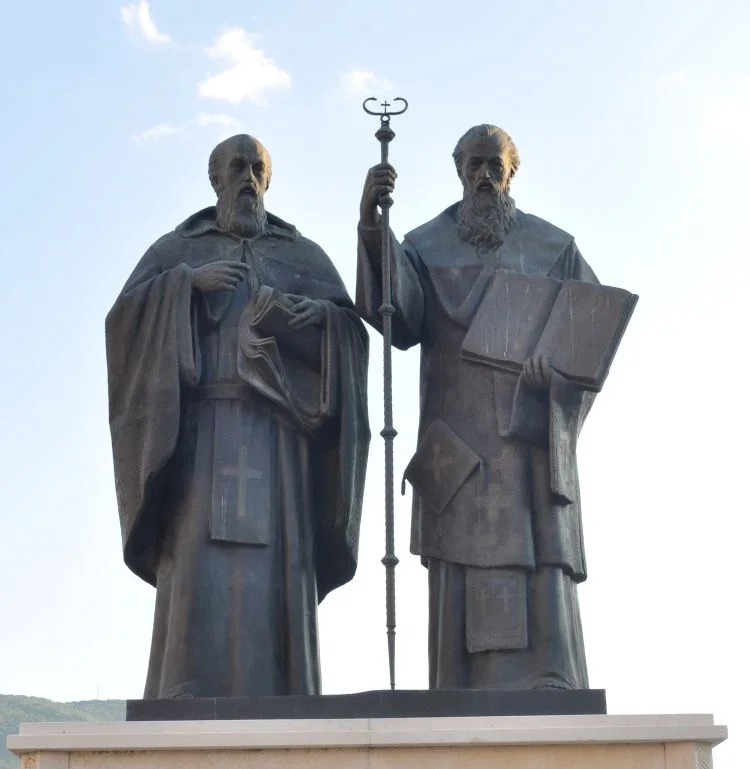
We are getting here to a very interesting but also very complex matter- the creation of the Cyrillic. On both sides of the alley, you will see 2 monuments- one is dedicated to Saint Cyril and Methodius, and the other to Saint Clement of Ohrid and Naum. To understand the processes that were ongoing in this crucial 9th century that impacted the future development of all Eastern Europe, we have to get a bit deeper into the history. Please note, that we will really just scratch the complexity of those events, and we won’t be able to explain everything in detail but we have to limit ourselves to avoid turning the audio guide into an audiobook.
So, the story of the Cyrillic alphabet begins with Saints Cyril and Methodius, two remarkable Byzantine brothers whose diplomatic and religious missions reshaped the cultural landscape of the Slavic world. Cyril (originally named Constantine) and Methodius were born in Thessalonica in the 9th century. They probably had a Bulgarian or Slavic origin. In the 860s, Cyril and Methodius were entrusted with a mission that went beyond religious instruction. The brothers were first dispatched to Crimea, where Cyril reputedly discovered the relics of Saint Clement, a revered early Christian figure, and engaged in dialogues with the Khazars about faith. This early mission solidified their status as emissaries of the Byzantine Empire, promoting Orthodox Christianity and fostering political alliances in diverse regions. As we know, these were the first steps that led a century later Byzantine, and Orthodox Christianity, to penetrate successfully in Kyiv Rus. But this is another long story.
Their most famous mission, however, took them to the Slavic state of Great Moravia in Central Europe. In 863, the Moravian prince Rastislav requested a mission from Byzantium as a counter-move against the power of the East Frankish ruler of Louis the German. As a result, the Byzantine Emperor Michael III saw an opportunity to expand Byzantine influence in Central Europe through peaceful means rather than military intervention. The brothers were sent, and Cyril developed the Glagolitic alphabet, the first written script specifically designed for the Slavic language, which allowed the translation of key Christian texts into a language the Moravians could understand. With the Glagolitic alphabet, Cyril and Methodius translated the Bible and other essential liturgical works into Old Church Slavonic. They trained local priests and established an educational system in Great Moravia to ensure that the newly converted Slavs could participate in Christian worship in their native language. The goal was to foster a self-sustaining Christian community that would not rely on Latin-speaking priests sent from the Frankish territories. The mission met significant resistance from the Frankish clergy, who viewed the use of Old Church Slavonic as a direct challenge to their authority and to the dominance of the Latin language in religious practices. The Frankish clergy advocated the view that only Hebrew, Greek, and Latin were suitable for liturgical use, an argument known as the "Trilingual Heresy." This led to tensions between the Byzantine missionaries and the Latin Church, which considered the spread of a Slavic Christian tradition as undermining their control over Moravia. Cyril and Methodius traveled to Rome to seek papal approval of their efforts. Pope Adrian II approved their mission, endorsing the use of Old Church Slavonic in liturgy and ordaining their disciples. Cyril, however, died in Rome in 869, and Methodius returned to Moravia to continue the mission alone. Unfortunately, after Methodius’s death in 885, the mission suffered setbacks as the Latin clergy intensified their efforts to restore Latin liturgy and suppress Slavic worship. Under political pressure from the Frankish clergy, many of the disciples of Cyril and Methodius were expelled from Great Moravia. Seeking refuge, they found a welcoming environment in Bulgaria, where Khan Boris I recognized the value of a Slavic Christian tradition that would unify his people. Two decades earlier, to consolidate power and unify the two main ethnicities in the Bulgarian state, Khan Boris I recognized the potential of Christianity as a unifying force. Boris converted to Christianity in 864, adopting the Christian name Michael, and established Christianity as the official religion of Bulgaria. This conversion was partly a diplomatic maneuver to secure alliances with Byzantium and avoid the cultural influence of the Roman Catholic West. Boris I, enforced Christianity with determination, seeing it as the key to solidifying a single Bulgarian identity that bridged both the Bulgarians and Slavic populations.
In Bulgaria, the disciples, including Saint Clement of Ohrid and Saint Naum, refined the Glagolitic alphabet into what became the Cyrillic alphabet. The motives behind this act of change were the necessity of the Bulgarian state to stop and decrease the influence of Constantinople. Boris’s son, Tsar Simeon the Great, inherited his father’s vision and expanded it further. Under Simeon, Bulgaria experienced a cultural renaissance known as the Golden Age. Simeon, who had been educated in Constantinople, fostered a court of scholars, theologians, and writers who utilized the Cyrillic alphabet to produce an impressive body of religious and secular literature. This literary blossoming made Bulgaria a cultural and intellectual powerhouse in the Slavic world, rivaling even Constantinople.
With the establishment of literary centers in Preslav and Ohrid, the Cyrillic script spread across the Slavic-speaking world, from the Balkans to Eastern Europe, and later in Kyiv Rus. It became the foundation for the written languages of Russia, Serbia, and other Orthodox Christian Slavic nations, forming a linguistic legacy that continues to this day.
41.99749, 21.43416