The Fortress of Skopje
Back to all places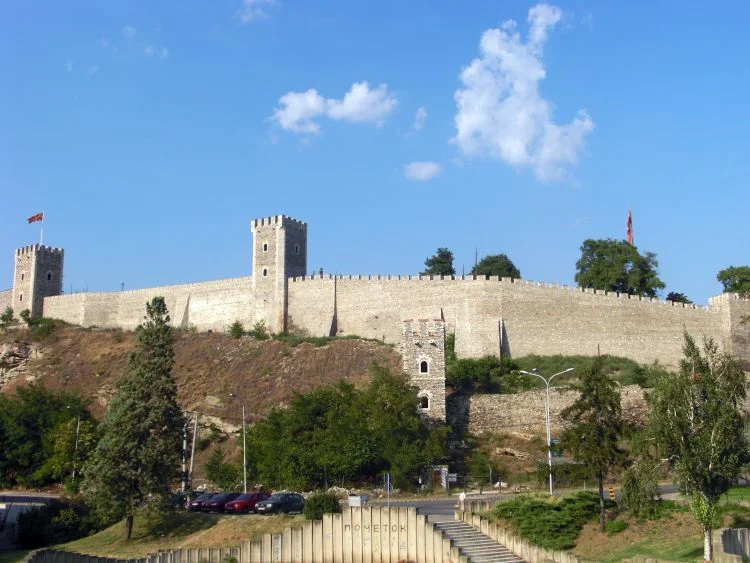
The history of this hill began over 7,000 years ago with Neolithic farmers, notably at the nearby site of Tumba Madzari. By the Iron Age, the region was inhabited by the Paeonians and later the Dardanians, who established Scupi as their capital. While the territory of Skopje was never part of ancient Macedonia proper, its destiny was touched by the rise of Philip II and Alexander the Great. Alexander respected the local Triballians—a "furious Thracian tribe"—for their military prowess; after crushing them in 335 B.C. to secure his borders, he integrated them into his army as some of his best assault troops.
Scupi transitioned into a Roman power center in 28 B.C., serving as a veteran settlement for the VII Legion. Officially designated as Colonia Flavia Scupinorum by the 1st century A.D., it became a strategic intersection for trade where Latin was the common language. This prosperity ended abruptly in 518 A.D. when a massive earthquake—the largest in the city’s history—completely destroyed the Roman provincial capital.
In the wake of this disaster, the Byzantine Emperor Justinian I ordered the survivors to relocate to this defensible hilly plateau. He used massive stone blocks scavenged from the ruins of Scupi to build a new fortified city known as Justiniana Prima, the direct predecessor of the Kale Fortress.
The ethnic composition of the region shifted again in the 6th and 7th centuries. Raiding Slavic tribes began to penetrate the area from the north, eventually occupying the strategic heights by the 7th century. These new settlers abandoned the name Justiniana Prima and renamed the city Skopje.
In the 830s C.E., Skopje became a vital part of the First Bulgarian Empire. Its prestige grew to such heights that it served as the Bulgarian capital from 972 to 992 C.E.. During the era of Tsar Samoil, the fortress was given immense political and strategic importance. Samoil enacted new defensive walls specifically to protect the kingdom’s treasures housed within the settlement. One notable entrance was the "Watertower Gate," designed to defend against Byzantine attacks.
The decline began in 1004 when the Bulgarian governor, Roman, surrendered the city to Byzantine Emperor Basil II in exchange for the titles of patrician and strategos. The final "disaster" for the First Bulgarian State arrived in 1018, when the empire collapsed, and the fortress fell under Byzantine rule.
Resistance persisted, most notably in 1040 when Peter Delyan, claiming to be the grandson of Samoil, led a massive uprising that spread through the Balkans after he was proclaimed Tsar in Belgrade. By the late 11th century, Skopje had become a battleground for the Normans of Sicily, who held the city during their wars with Byzantium until 1088. The city was eventually reclaimed for the Second Bulgarian State in 1203 by Emperor Kaloyan.
Skopje fell to the Ottoman Empire in 1392 and was renamed Uskub. Under Ottoman rule, the Kale was modified with gunpowder storage rooms and watchtowers, serving as a military stronghold and slave market. A devastating moment occurred in October 1689, when the Austrian General Piccolomini ordered the city burned to the ground; it burned for two days, significantly reducing the population.
In 1963, Skopje was hit by a devastating earthquake that destroyed much of the city and left the fortress severely damaged. After the earthquake, significant reconstruction efforts were undertaken to restore the fortress, preserving its historical integrity while also preparing it for future generations. Today, the fortress stands partially reconstructed, with ongoing preservation efforts that aim to maintain its historical appearance while making it accessible to visitors.
As you walk along the walls of the fortress, you’ll find yourself immersed in Skopje’s history while enjoying sweeping views of the Old Bazaar, the Vardar River, and the contrasting modern skyline of the city center. Look out toward the Mustafa Pasha Mosque, the clock tower, and the numerous domes and minarets of the Bazaar. On a clear day, the view stretches over the city to the distant mountains.
Within the fortress, you’ll see remnants of ancient walls, watchtowers, and the foundations of what were once storage buildings and barracks. The fortress’s outer walls remain strong, and several of its towers still stand, allowing you to imagine the grandeur and scale of its past defenses. Informational displays are placed along the paths to guide you through the rich timeline of this site.
Today, Skopje Fortress is not just a historic monument but also a place for community gatherings and events, adding a modern layer to its legacy. Standing here, you can feel the resilience of Skopje and the fortress itself—a testament to the city’s survival through centuries of conquests, natural disasters, and rebirth. Enjoy the view, and let the echoes of history accompany you as you explore this enduring symbol of Skopje’s past.
42.00183, 21.43249