The father of Alexander
Back to all places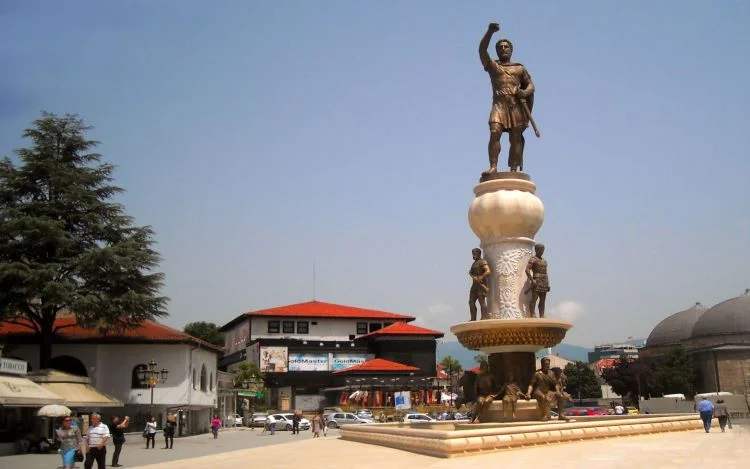
Now we will talk about the second extraordinary parent of Alexander, who also contributed to the divine nature of Alexander by connecting his family tree to Hercules himself. Without a possibility for an argue, we can say that Phillip II is one of the most exceptional men lived on this planet. He definitely deserves the title The Great. Philip II of Macedon, celebrated for his strategic brilliance and leadership, was an influential ruler who transformed Macedonia from a minor, often chaotic kingdom into a dominant military power in the Greek world. Ancient accounts portray him as resilient, visionary, and pragmatic, qualities that allowed him to reshape his kingdom’s political landscape and legacy. Philip combined courage and cunning in his character. Known to lead from the front in battle, he suffered multiple injuries, including the loss of an eye and a debilitating leg wound. Rather than hide his scars, Philip displayed them proudly, treating them as symbols of valor and dedication to his kingdom. The Roman historian Plutarch remarked on this aspect, suggesting that Philip’s scars were "symbolic representations, cut into his body, of virtue and courage," highlighting his unyielding spirit and willingness to endure physical hardship for his people. Philip’s qualities extended beyond his valor; he was also a skilled military innovator and organizer. By introducing the formidable sarissa (a 14-18 foot spear) and revamping the Macedonian phalanx, he created one of the most effective fighting forces in Greece. Under his command, Macedonia’s army grew from a part-time militia to a standing professional force with over 24,000 infantry and 3,000 cavalry, a scale unmatched by any Greek city-state at the time. His military innovations not only secured his conquests but also set the foundation for Alexander’s future campaigns. Philip’s diplomatic acumen was equally remarkable. He unified Macedonia through strategic marriages, and his calculated alliances with regional powers allowed him to consolidate his influence without unnecessary warfare. Through the League of Corinth, he achieved something no Greek leader had managed before: a united Greece under his leadership, with shared military aims, specifically the ambitious plan to invade Persia. The breaking point of his dominance over the Greek states was the Battle of Chaeronea in 338 when Philip had defeated the combined forces of Athens and Thebes.
Philip’s personal life was marked by complexity and controversy, especially regarding his relationships and marriages, especially regarding his marriage with Olympias. Philip’s relationships also extended to personal bonds within his court, including those with members of his royal bodyguard. Among these was Pausanias of Orestis, who would later become his assassin. According to historical sources, Pausanias was involved in a complex and scandalous relationship that included another courtier, also named Pausanias, who had been favored by Philip. This other Pausanias eventually fell out of favor and allegedly sacrificed himself heroically to prove his loyalty to Philip. The first Pausanias, jealous and feeling slighted, publicly insulted the deceased Pausanias, infuriating Attalus, Cleopatra’s powerful uncle. In retaliation, Attalus orchestrated a brutal assault on Pausanias of Orestis, which deeply humiliated him. Pausanias sought justice for the assault from Philip, but the king did not act against Attalus, likely due to his influential position as Cleopatra’s guardian. According to Plutarch and other sources, Pausanias’s resentment festered over this betrayal, ultimately driving him to assassinate Philip. His anger toward the king was compounded by his perception of Philip’s betrayal, both as his king and his former lover. The assassination occurred in 336 BCE at Aegae during the wedding celebrations of Philip’s daughter Cleopatra to Alexander I of Epirus. Philip, unarmed and dressed in a white robe symbolizing his claim to divinity, entered the theater in a grand procession, surrounded by dignitaries from across Greece. As he approached the center of the theater, Pausanias of Orestis seized the moment to strike, fatally stabbing Philip. Pausanias attempted to flee to waiting horses, but he was quickly caught by Philip’s bodyguards and killed on the spot. Philip’s assassination led to a wave of speculation about possible conspirators. Many believed Olympias had encouraged Pausanias, both due to her hatred of Cleopatra Eurydice and her desire to secure Alexander’s succession. According to some sources, Olympias not only praised Pausanias but arranged for horses to aid in his escape. After Philip’s death, she reportedly displayed shocking reverence for Pausanias by crowning his corpse with gold and honoring him in ways that suggested her complicity. In the power vacuum that followed, Alexander swiftly secured his position as king, but the shadow of his father’s assassination—and the possible involvement of his mother—remained a lasting controversy in Macedonian history. Of course, many others wanted the death of Phillip. Just imagine how the Greek city-states were feeling about his dominance, or the Persians, when one of the greatest commanders of all times, who just united the Greek world under his banners and openly prepared the invasion against the King of Kings. But some truths will never come out of the fog of mysticism and speculations. While listening to this fascinating ancient intrigue, I imagine it is very possible that you could have thought about J.F. Kennedy’s assassination, isn’t it?
41.99834, 21.43486