Alexander III
Back to all places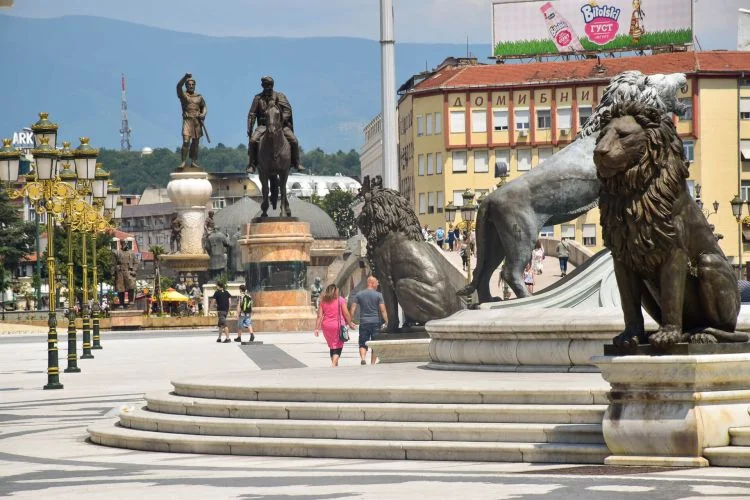
The time has come to talk about the most famous leader of Ancient Macedonia, Alexander III. You have already heard about his parents, and by their story, you can imagine what Alexander’s character might have looked like.
You’re now standing before the majestic statue of Alexander III of Macedon, known to history as Alexander the Great. This statue is a striking tribute to one of the most extraordinary figures in history—a man whose ambition and vision forever changed the ancient world. The sight of Alexander riding his rearing horse, Bucephalus, captures the essence of a leader who was as fearless as he was ambitious.
Alexander was born in 356 BCE in Pella, the capital of Macedonia. From a young age, Alexander exhibited a natural intelligence and a strong will, qualities that would shape his future. His education was overseen by none other than Aristotle, one of the greatest philosophers of the time. Aristotle taught him philosophy, science, medicine, and the arts, while also instilling in him the values of leadership and ethics. This education fostered Alexander’s deep fascination with heroic legends, particularly the story of Achilles, the hero of the Iliad and Alexander’s idol. This obsession was also increased by the mythical lineage of his mother to this formidable warrior. Plutarch recounts how Alexander would sleep with a copy of Homer’s Iliad under his pillow, inspired by the exploits of the Greek hero. The works of another ancient author played a significant role in the future of Alexander- those of Xenophon in which he describes his adventures in Persia during the legendary March of the Ten Thousands.
Alexander’s relationship with his father, Philip, was complex. Philip’s achievements—transforming Macedonia into a powerful kingdom and expanding its territories—became both a source of pride and competition for Alexander. When Philip married Cleopatra Eurydice, Alexander’s position as heir felt threatened, leading to a temporary estrangement. Yet despite this tension, Alexander proved his leadership abilities early. At just 16, he was left in charge of Macedonia as regent while Philip campaigned, and he quelled a rebellious Thracian tribe, displaying tactical skill that impressed even his father.
His first major challenge as a leader came at the Siege of Thebes in 335 BCE. After Philip’s assassination, Alexander ascended to the throne and faced revolts from Greek city-states. Thebes, attempting to regain its independence, was besieged by Alexander, who ultimately razed the city to send a strong message to others. This victory solidified his control over Greece and established him as a formidable ruler.
Driven by his father’s ambition and a personal desire for glory, Alexander embarked on his legendary conquest of the Persian Empire in 334 BCE. He won decisive victories at the Battle of Granicus, Issus, and Gaugamela, each battle showcasing his brilliant military strategy and fearless approach. In his pursuit of Darius III, the Persian king, Alexander conquered vast territories and effectively dismantled the Persian Empire. His campaign forever altered not only the political landscape of the ancient world but also the cultural one, as he sought to integrate Persian customs with Greek practices.
As Alexander delved deeper into Persian culture, his own identity began to evolve. He adopted elements of Persian dress and customs, even taking Persian wives, which alarmed many of his Greek and Macedonian soldiers. His transformation reflected his vision of a vast, unified empire, though it also introduced tensions among his followers.
In 332 BCE, Alexander arrived in Egypt, which was then a Persian province. The Egyptians, weary of Persian rule, welcomed Alexander as a liberator. Without a fight, he was declared Pharaoh of Egypt and recognized as a god in the Egyptian tradition. He founded the city of Alexandria, envisioning it as a center of learning and commerce. His time in Egypt deepened his sense of divinity, reinforced by a visit to the Oracle of Siwa, where he was hailed as the son of Zeus-Ammon, further encouraging his belief in his own divine mission.
Alexander’s final campaigns took him as far as India, where he faced fierce resistance and suffered significant losses. Exhausted and increasingly autocratic, he turned back. In 323 BCE, in Babylon, he fell seriously ill and died at the age of 32, possibly from a fever or poisoning, though the exact cause remains a mystery. His death left his empire without a clear successor, as his son, Alexander IV, was still unborn. His passing triggered a power struggle among his generals, known as the Diadochi, who divided his empire among themselves.
After Alexander’s death, his body became a symbol of legitimacy, and his general Ptolemy saw an opportunity. He intercepted the funeral procession and took Alexander’s body to Egypt, where it was enshrined in Alexandria. Over the centuries, Alexander’s tomb became a revered site, but it eventually vanished from history. The exact location of his final resting place remains a mystery, though it is believed to be somewhere in Alexandria.
Following Alexander’s death, his empire was divided among his generals. Ptolemy took Egypt, establishing the Ptolemaic Dynasty that would rule for nearly 300 years. One of the most famous members of this Macedonian family is the Egyptian Queen Cleopatra. Seleucus claimed the eastern territories, founding the Seleucid Empire, while Antigonus, Lysimachus, and Cassander carved out realms in Macedonia and Asia Minor. This division marked the beginning of the Hellenistic Era, a period characterized by the spread of Greek culture, language, and ideas across the eastern Mediterranean and into Asia.
The Hellenistic world became a melting pot of Greek and Eastern traditions, fostering advancements in science, philosophy, art, and architecture. Cities like Alexandria became centers of learning and innovation, leaving a lasting legacy on Western and Eastern civilizations alike. The blending of cultures initiated by Alexander’s conquests transformed the ancient world and paved the way for future empires, cementing his reputation as one of history’s most influential figures.
As you stand before this statue, take in the legacy of a man who, in a brief lifetime, reshaped the world. Alexander’s ambition, vision, and charisma made him a hero, a conqueror, and a legend whose impact resonates to this day.
41.99595, 21.43151